What is political party registration in India?
Political party registration is the process by which an
association or body of persons is registered as a political
party with the Election Commission of India under Section 29A of
the Representation of the People Act, 1951.
Who registers political parties in India?
The Election Commission of India registers political parties.
Applications are made to the Commission in the prescribed
format, following its published guidelines.
How do I register a political party in India?
The usual steps are to form the association, adopt a
constitution with the mandatory provisions, publish the proposed
party name in newspapers to invite objections, and submit the
application with documents and the processing fee to the
Election Commission. Always check the latest ECI guidelines
before you begin.
What is the time limit to apply for party registration?
Under the Election Commission's guidelines, the application must
be submitted within 30 days following the date of formation of
the party. Founders should prepare documents in advance so that
the window is not missed.
What documents are required to register a political party?
The application is accompanied by the party constitution,
details of office bearers and the executive, supporting
documents and affidavits listed in the ECI guidelines, proof of
the public notice and the processing fee. The exact list is set
by the Commission and can change, so we confirm it before filing.
What is the fee for registering a political party?
The Election Commission charges a non-refundable processing fee,
which has been ₹10,000 under its guidelines. This is separate
from consultant fees, newspaper notice costs and taxes, which
should be listed separately in a proposal.
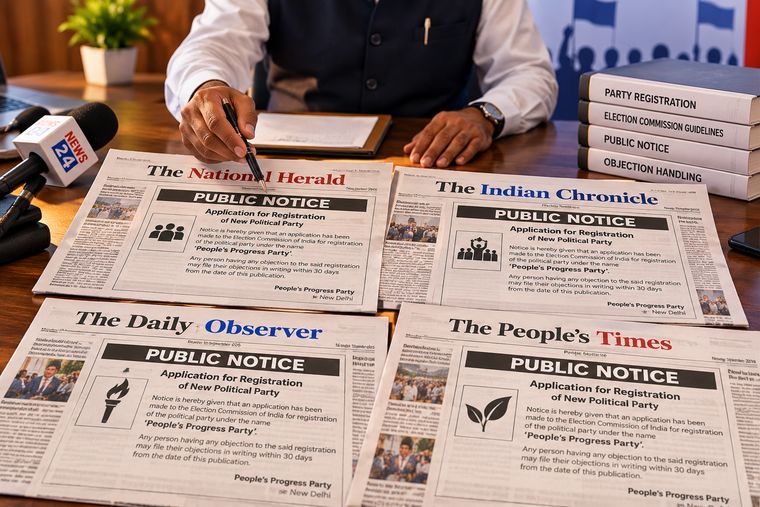
Why is a public notice published in newspapers?
The guidelines ask the applicant to publish the proposed party
name in two national and two local daily newspapers, so that
anyone with an objection can write to the Commission within the
stated period. Proof of publication supports the application.
How long does political party registration take?
Timelines depend on how quickly the documents are completed, the
objection period after the notice, any queries from the
Commission and its processing time. We share a working schedule
in the proposal, but we cannot promise a fixed date for the
Commission's decision.
What is the difference between a registered and a recognised party?
A registered party has been entered on the Commission's list
under Section 29A. A recognised state or national party has also
met the conditions of the Election Symbols (Reservation and
Allotment) Order, 1968, usually through election performance.
Registered but unrecognised parties generally choose from the
Commission's list of free symbols.
Can a registered unrecognised party contest elections?
Yes, a registered party can field candidates, subject to the law
and the Commission's rules. It generally chooses a symbol from
the free symbols list rather than holding a reserved one.
Can the Election Commission reject a party name or application?
The Commission examines each application, including objections
and the proposed name. Applications can be queried or refused if
requirements are not met. Careful preparation of the name,
constitution and documents reduces that risk, but it cannot be
removed entirely.
Does Political Metrics provide political party registration services in India?
Yes. Political Metrics can support formation advice, constitution
drafting, public notice preparation, application documentation,
filing coordination and post-registration compliance. The scope
is agreed in a written proposal before work begins.
What compliance is required after a party is registered?
Registered parties are expected to follow their constitution,
keep accounts, submit audited financial statements and
contribution reports as required, and inform the Commission of
changes such as a new name, address or office bearers. We help
set up a compliance calendar for these tasks.
Can you support parties outside Delhi and in any state?
Yes. Registration is with the Election Commission, but we can
work with founders in any state or union territory, including
coordination of local newspaper notices.
Is client information kept confidential?
Party formation involves sensitive political and personal
information. Confidentiality terms, data handling and access to
documents should be agreed in writing as part of the engagement.